
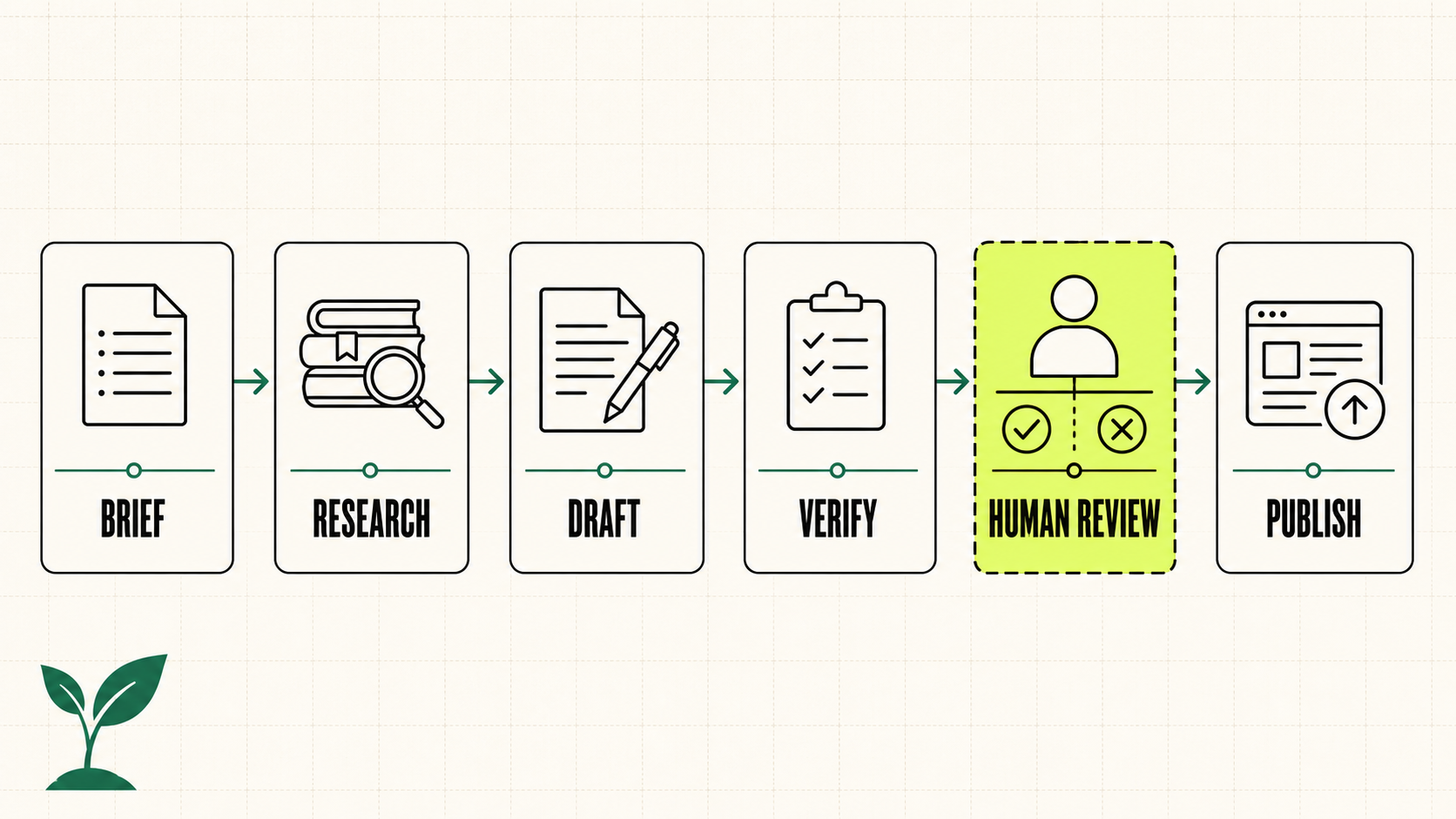
AI-assisted drafts can make content production more flexible, but a fluent draft is not a publish decision. The editorial workflow still needs to prove that the article is accurate, useful, original, accessible, aligned with search intent, and appropriate for the brand.
Google does not say that content is penalized simply because AI helped create it. Its guidance focuses on quality, originality, people-first purpose, and whether automation is used primarily to manipulate search rankings. That makes human review a risk-control system—not a ceremonial final read.
Classify risk before assigning reviewers
Review depth should match the possible harm of an error. This is a practitioner workflow recommendation, not a Google requirement.
| Risk level | Typical examples | Minimum review |
|---|---|---|
| Lower | Idea lists, summaries of owned material, non-sensitive landing-page variants | Editor checks brief, claims, overlap, links, metadata, and brand fit |
| Medium | SEO guides, product comparisons, customer education, executive-supporting content | Editor plus source verification and a knowledgeable product or subject reviewer |
| High | Health, legal, financial, safety, compliance, crisis, or sensitive policy content | Qualified subject-matter review and any required legal, compliance, or executive approval |
Record the risk level in the content brief. If a topic requires expertise the team does not have, the correct action may be to pause publication rather than polish the prose.
Gate 1: approve the brief before generation
A strong review starts before the draft exists. The brief should identify the audience, search intent, reader task, business purpose, primary topic, required questions, approved sources, internal-link targets, prohibited claims, desired call to action, and responsible reviewers.
Define acceptance criteria in plain language. For example: “Use current product documentation for feature claims,” “Do not estimate ROI,” or “Explain where the recommendation does not apply.” A reviewer can then compare the draft with an agreed standard instead of inventing the standard at the end.
Connect briefs to a realistic publishing sequence with a 90-day SEO content plan.
Gate 2: verify every consequential claim
Review facts before style. Mark each number, date, quote, product capability, price, legal statement, technical instruction, and causal claim. Open the cited source and confirm that it directly supports the sentence, is current enough for the context, and comes from the most authoritative available publisher.
- Prefer first-party documentation, standards bodies, original research, regulations, and official datasets.
- Distinguish a source’s finding from the article’s interpretation.
- Remove claims that cannot be verified; do not soften them into vague language and leave the implication intact.
- Check that links resolve to the specific supporting page, not a generic home page.
- For changing information, record the access or review date when useful.
Do not rely on AI-generated citations without opening them. A plausible title, quotation, or URL can still be incorrect. The editor owns the published claim even when a model produced the first draft.
Gate 3: test usefulness, originality, and search intent
Compare the draft with the brief and the existing content library. Does it answer the reader’s main question early? Does each section add information, a decision rule, an example, or a useful next step? Remove repeated summaries and generic filler.
Run an overlap review against published and queued articles. Two pages may discuss related themes without being duplicates, but each should have a distinct intent and reason to exist. If the draft competes with a stronger existing page, refresh or consolidate instead of publishing another weak variation.
Google’s people-first guidance asks whether content provides original information or analysis, substantial coverage, clear sourcing, and a satisfying experience. It also encourages clarity about who created content, how it was produced when that context matters, and why it exists. Use these prompts to improve the article, not as a formula that guarantees rankings.
For libraries already showing overlap, use the SEO content audit framework for agencies and the guide to programmatic SEO without thin or duplicate pages.
Gate 4: apply subject-matter and brand review
A subject-matter expert should examine reasoning, missing caveats, terminology, and real-world applicability—not only spelling. Ask the reviewer to identify what a practitioner would challenge, what changes by scenario, and which recommendation needs a boundary condition.
The brand editor then checks voice, audience assumptions, examples, and calls to action. Replace generic authority language with evidence. Remove claims that the company is “best,” “leading,” or “guaranteed” unless an approved source and context justify them. SiteSeed should appear where it genuinely helps the workflow, not in every section.
Gate 5: review links, metadata, and images
Check internal links after the structure is stable. Each link should help the reader continue a related task, use descriptive anchor text, and point to the canonical live URL. Avoid adding many links merely to reach a quota. A repeatable approach is documented in scaling internal links across topic clusters.
Review the title, meta description, URL slug, headings, and featured image as part of the same editorial pass. They should accurately represent the article without overpromising. Confirm that the social preview and image crop remain readable at smaller sizes.
W3C’s Web Accessibility Initiative explains that informative images need text alternatives that convey their essential information, decorative images should use an empty alt attribute, and functional images need alternatives describing their function. Charts and workflow diagrams may also need nearby text that communicates the same conclusion.
- Verify image rights, source, crop, and brand consistency.
- Use meaningful alt text for informative images; do not stuff keywords.
- Ensure the article remains understandable when an image cannot be seen.
- Check heading order, link meaning, table clarity, and readable contrast in the published template.
Gate 6: make publication approval explicit
The final approver should see a compact record: brief status, risk level, source-check result, SME approval when required, overlap result, accessibility check, internal links, metadata, and unresolved exceptions. A checkbox is useful only when it represents work that someone actually performed.
Separate roles where practical. The drafter can resolve edits, but another person should approve consequential claims. High-risk content may require multiple named approvers. Preserve the decision trail so later updates do not repeat the entire investigation.
Do not use AI-detector scores as proof of authorship
AI-detection tools can be used as a weak editorial signal for repetitive or formulaic language, but their scores do not prove who wrote a passage. Do not reject work, accuse a contributor, or claim compliance based only on a detector result. Review the actual qualities that matter: evidence, reasoning, originality, specificity, and usefulness.
Plan post-publish corrections
Publication is not the end of review. Define how readers and team members can report an error, who triages it, and how quickly high-risk inaccuracies are escalated. Correct the page, update affected links or assets, and record material changes when transparency would help readers.
Schedule refresh reviews based on topic volatility rather than an arbitrary universal interval. Pricing, regulations, product interfaces, and statistics may need closer monitoring than evergreen principles. The content-refresh workflow provides a structured update process.
How SiteSeed supports the workflow
SiteSeed can carry the approved brief through research, drafting, rendering, verification, featured-image generation, categorization, and a review queue. Editors can then focus on the decisions automation cannot own: whether a source truly supports a claim, whether the article adds value, whether expert review is sufficient, and whether publication is responsible.
This is how teams can scale blog content without hiring writers while keeping human accountability at the publication boundary.
Publish-ready checklist
- The brief, audience, intent, risk level, and approvers are recorded.
- Every consequential claim has been verified against an appropriate source.
- The article adds a distinct angle and does not unnecessarily compete with existing content.
- Subject-matter, brand, legal, or compliance review is complete where required.
- Internal links, metadata, images, alt text, and page structure have been checked.
- No detector score is treated as proof of authorship or quality.
- A correction owner and future review trigger are defined.