
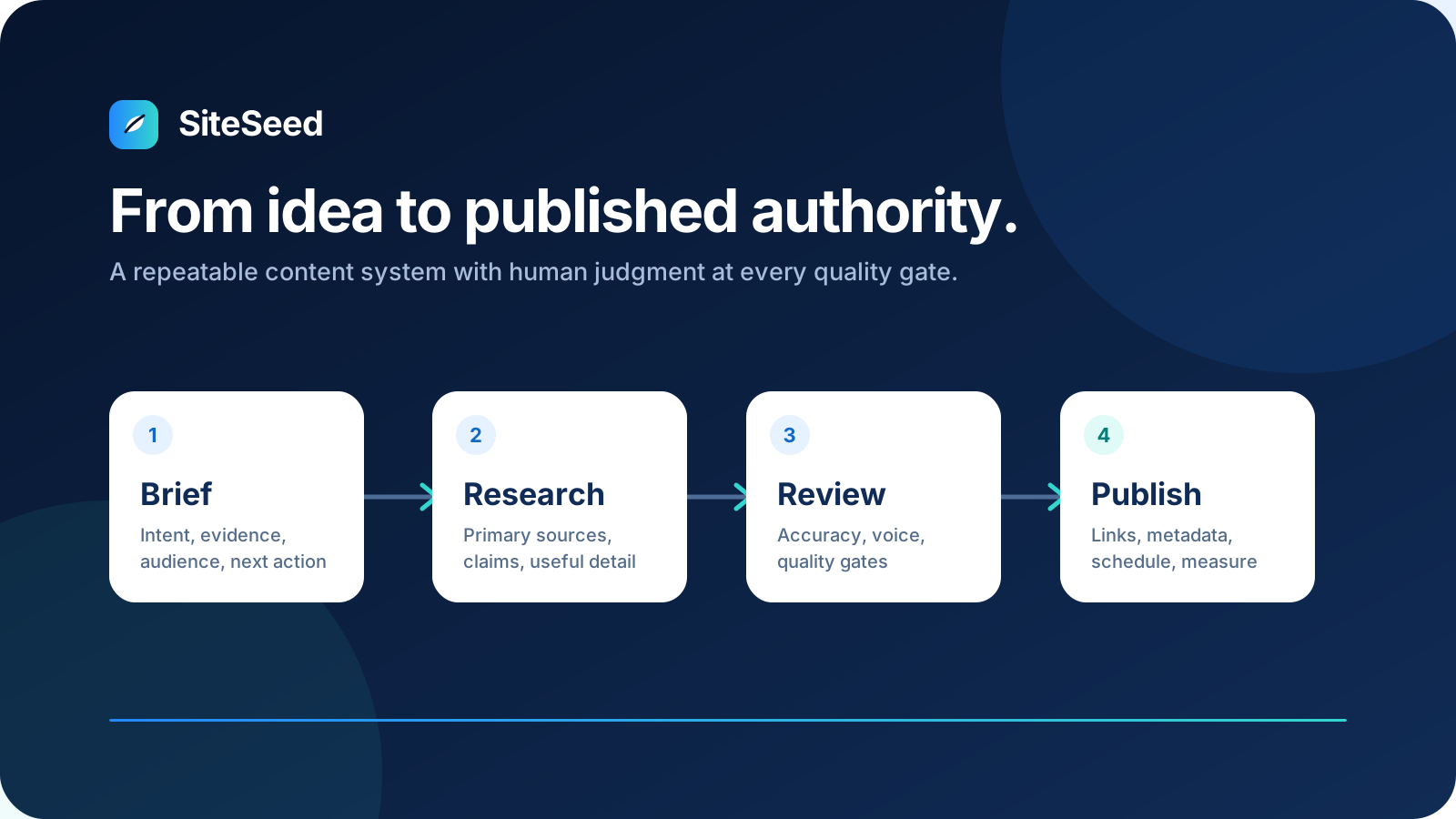
Scaling blog output is rarely a writing problem. It is an operations problem.
When every article starts with a blank page, a new research process, and a different approval path, adding volume creates more coordination work than useful content. The answer is not to remove human judgment. It is to standardize everything around it.
This guide shows SEO agencies and lean marketing teams how to scale blog content without hiring writers by building a repeatable content operating system: focused topic clusters, approved briefs, researched drafts, fixed review gates, intentional internal links, scheduled publishing, and measurable refresh cycles.
Start with capacity, not an arbitrary publishing target
“Publish more” is not an operating plan. First define how much editorial review your team can sustain without lowering standards.
Use this simple capacity model:
Monthly article capacity = available editorial hours ÷ average review hours per article
If one editor has 24 hours per month and a researched draft takes 90 minutes to review, the starting capacity is 16 articles—not 40. Improve the workflow until review time falls, then increase output. This keeps quality from becoming the hidden variable.
Track three baseline numbers for the first month:
- Average minutes from brief approval to publish
- Average editor time per article
- Percentage of drafts approved in one revision round
These are more useful early indicators than raw article count because they expose where the process is actually stuck.
Build one topic cluster before building a content calendar
A calendar tells you when to publish. A topic cluster tells you why each page exists and how it supports the rest of the site.
Choose one commercially relevant problem your audience needs to solve. Create one pillar page for the broad problem, then map 8–12 supporting articles around narrower questions, comparisons, workflows, and objections. That range is an operating default, not a ranking formula; adjust it to the depth of the subject and the quality of available evidence.
For an SEO agency audience, a “content operations” cluster might include:
- How to scale blog content without hiring writers
- How to build a 90-day SEO content plan
- AI content quality-control checklist
- How to refresh declining articles
- Internal linking workflows for growing sites
- How to measure content production efficiency
Assign every planned article a primary intent, a target reader, a next action, and at least two logical connections to other pages in the cluster. Google’s guidance recommends descriptive, crawlable internal links that help people and search engines understand related pages. Internal links should be planned before drafting, not added randomly at the end.
Create an approved brief backlog
The most expensive production gap is waiting for someone to decide what comes next. Maintain a backlog of 10–20 approved briefs so research and drafting can continue without another planning meeting.
Every brief should contain:
- Search intent: the job the reader is trying to complete.
- Primary and secondary queries: guidance for coverage, not a stuffing checklist.
- Required sections: the questions the page must answer.
- Evidence requirements: primary sources, dates, and claims that need verification.
- Internal-link targets: where the article belongs in the cluster.
- Conversion path: the useful next step after the reader gets the answer.
A good brief reduces creative ambiguity while leaving room for expert judgment. It also makes AI-assisted production safer because the model receives a clear scope and evidence standard instead of a title alone.
Separate automation from editorial judgment
AI works best as a production system, not an unsupervised author. Give automation the repeatable work and keep humans responsible for decisions that affect trust.
| Workflow stage | Automate | Keep human-owned |
|---|---|---|
| Planning | Keyword grouping, overlap checks, outline options | Audience priority and business fit |
| Research | Source discovery and claim extraction | Source quality and final evidence selection |
| Drafting | First draft from an approved brief | Original examples, experience, and point of view |
| Quality control | Broken-link, citation, structure, and duplication checks | Accuracy, nuance, tone, and legal or brand risk |
| Publishing | Formatting, metadata, schema, sitemap, and scheduling | Final approval |
This boundary is where SiteSeed is useful. It can turn the approved plan into researched drafts, check claims against the research brief, prepare metadata and internal links, and publish on schedule. The editor still decides whether the article deserves to represent the brand.
Use fixed quality gates instead of open-ended editing
More reviewers do not automatically create better content. They often create longer queues and contradictory feedback.
Use three explicit gates:
- Brief gate: Is the intent distinct, valuable, and supported by credible sources?
- Draft gate: Does every important claim have evidence? Is the answer complete and specific?
- Publish gate: Are the title, metadata, links, images, CTA, and mobile layout ready?
Limit routine articles to one consolidated revision round. If a draft repeatedly needs structural rewriting, fix the brief or workflow rather than normalizing extra editing.
Plan internal links as part of production
For each new article, add two to four contextual links to relevant existing pages. Then identify one or two older pages that should link forward to the new article. Exact numbers are less important than relevance; a useful link placed where the reader needs more detail is better than ten unrelated links in a footer.
Use descriptive anchor text. “See our content refresh workflow” communicates more than “click here.” Keep important pages reachable through normal HTML links, and include every canonical page in an XML sitemap. Google documents sitemaps as a discovery signal—not a guarantee of indexing—so combine them with strong site navigation and internal links.
Publish on a cadence the review system can sustain
Start with a four-week production cycle:
- Week 1: approve the cluster and 10–20 briefs
- Week 2: research and draft the first batch
- Week 3: review, revise, and publish
- Week 4: measure workflow performance and prepare the next batch
Once the system is stable, move to a rolling cadence where planning, drafting, and publishing happen in parallel. Do not increase frequency until the one-round approval rate and editor time remain stable for at least two cycles.
Refresh before the traffic decline becomes permanent
A scalable program maintains existing pages as deliberately as it creates new ones. Review priority pages every quarter and the rest at least every 6–12 months. Trigger an earlier review when impressions, clicks, conversions, or rankings decline consistently across a meaningful comparison period.
A refresh is not a date change. Recheck search intent, replace stale evidence, improve weak sections, repair links, add genuinely useful examples, and update the cluster’s internal links. If two pages compete for the same intent, consolidate them rather than polishing both.
Measure the operating system and the outcome
Use a small scorecard:
- Articles published per month
- Median editor minutes per article
- One-round approval rate
- Percentage of published pages with planned internal links
- Organic impressions and qualified visits by cluster
- Conversions assisted by content
- Pages refreshed, consolidated, or retired
A higher publishing count is not success if editor time, factual corrections, and orphaned pages rise with it. The goal is a system that produces useful pages repeatedly while preserving trust.
A practical next step
Choose one audience problem and map a 10-article cluster today. Approve the first five briefs, define your three quality gates, and measure editor time for one complete cycle. That gives you a real baseline before you scale.
If you want to see the workflow in practice, see how SiteSeed works. The Growth Lab itself is planned, written, reviewed, and grown with the same system described here.