
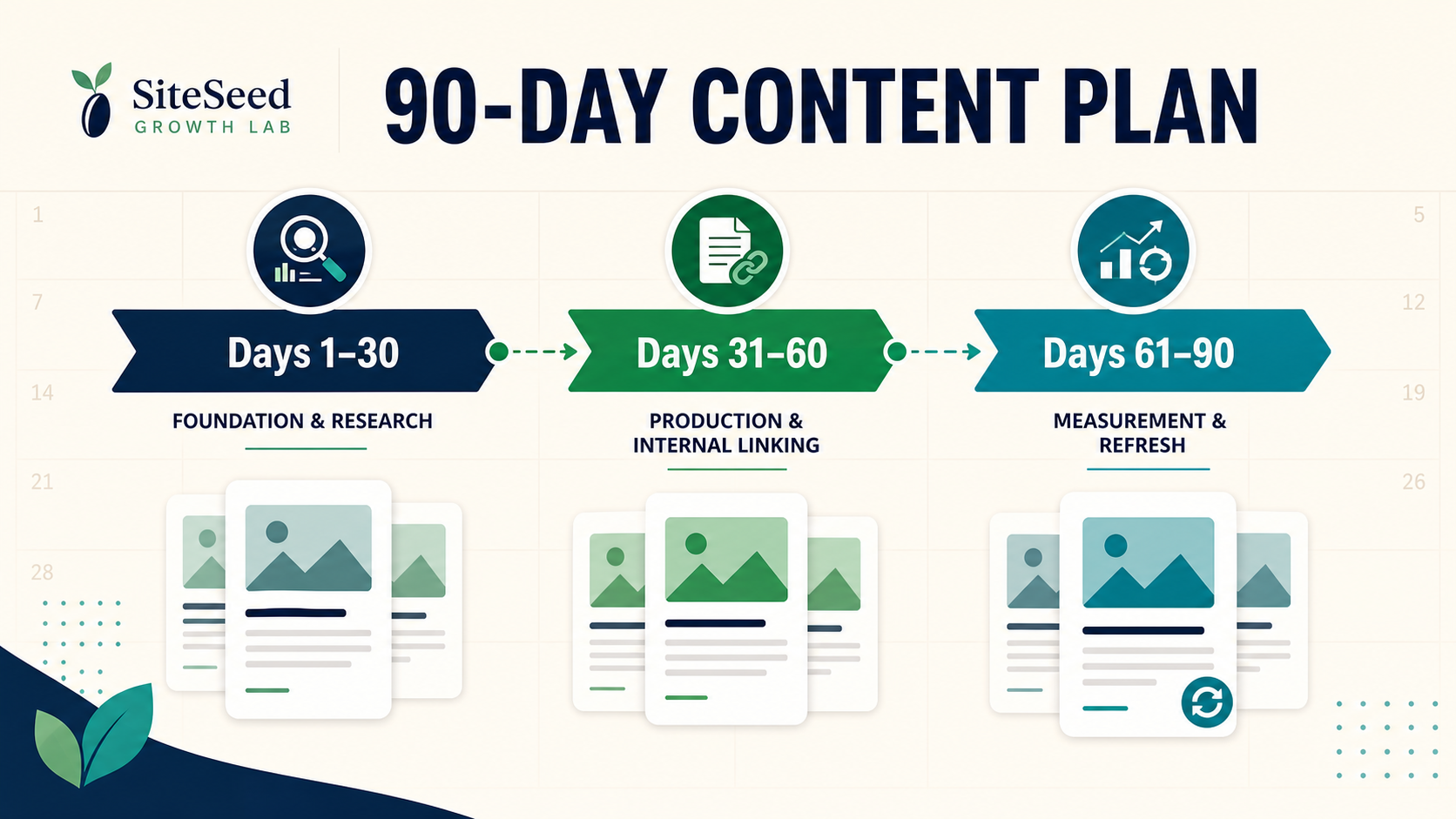
A useful 90-day SEO content plan is a capacity agreement, not a list of optimistic keywords. It connects customer problems, business priorities, existing content, research standards, publishing capacity, and review time. The plan should tell the team what to publish, what to refresh, what to postpone, and how to learn from each four-week cycle.
This framework is designed for SEO agencies and lean growth teams. The 13-week cadence is a practitioner recommendation rather than a Google requirement, and it makes no promise about traffic or ranking timelines.
Start with outcomes and constraints
Choose one primary business outcome for the quarter: support a product launch, build evidence around a service category, improve an underdeveloped topic cluster, or refresh content that already attracts qualified visitors. Add one or two supporting outcomes, but avoid asking the same plan to solve every marketing problem.
Record the constraints before selecting topics: writer and editor hours, subject-matter access, design support, review turnaround, publication permissions, and the number of existing pages that need maintenance. A plan that ignores review capacity will produce drafts faster than the team can verify them.
Define observable measures such as briefs approved, articles published, priority pages refreshed, internal-link actions completed, and conversion paths added. Search impressions, clicks, and qualified leads are useful outcomes, but they should be interpreted over time rather than treated as guaranteed results of a fixed publishing count.
Build the content inventory
List published pages with their purpose, cluster, last meaningful update, current status, and next recommended action. Mark pages that are outdated, duplicated, disconnected from navigation, or still useful as they are. This prevents the calendar from adding new articles where consolidation or maintenance would better serve readers.
Group opportunities by customer problem instead of keyword wording alone. A practical cluster may include an introductory guide, an implementation workflow, a comparison, a troubleshooting article, and a case study. Each page should have a distinct job.
For maintenance decisions, use the SiteSeed content-refresh workflow to evaluate relevance, evidence, intent, technical health, and publication readiness.
Calculate realistic quarterly capacity
Use a simple formula: available production hours divided by average hours per completed article. Count research, briefing, drafting, expert review, editing, image work, CMS preparation, and final QA. Then reserve 15% to 25% for revisions, delays, and unplanned updates. The correct reserve depends on team stability and topic complexity.
Separate new production from maintenance. For a mature site, allocating roughly one quarter to one third of capacity to refreshes and consolidation can be a useful starting hypothesis, not a universal rule. Review the allocation after the first month based on actual backlog and performance.
| Workstream | Example quarterly allocation | Purpose |
|---|---|---|
| New cluster content | 50% | Fill confirmed customer-information gaps. |
| Refresh and consolidate | 25% | Maintain useful pages and reduce overlap. |
| Case studies and conversion support | 15% | Connect education to product evidence. |
| Experiment reserve | 10% | Test one new format or respond to change. |
Replace these example percentages with numbers based on your own backlog and resources.
Plan the 13-week sequence
Weeks 1–2: research and decisions
Interview sales, support, customer success, and subject-matter experts. Review site search, customer questions, existing articles, and competitor coverage. Confirm page intent, evidence sources, internal-link relationships, and the conversion path before approving a brief.
Weeks 3–6: publish the first cluster batch
Produce a small connected batch rather than isolated posts. Start with the page that establishes the cluster's main problem, then add supporting pages that answer narrower decisions. Review each article before publication and connect relevant pages using descriptive anchors.
Weeks 7–9: refresh and consolidate
Apply what the team learned to existing pages. Update evidence, align intent, merge overlapping content where appropriate, repair links, and add contextual connections to the new cluster. Do not change publication dates merely to make pages appear fresh.
Weeks 10–12: second production batch
Publish the next briefs only after reviewing quality and workflow data from the first batch. Adjust scope if research or approval took longer than planned. A smaller completed batch is more useful than a large queue of unfinished drafts.
Week 13: review and reset
Compare planned and completed work, document bottlenecks, review search and conversion observations, and decide which unfinished items still deserve priority. Carry work forward only with an explicit reason.
Use fixed quality gates
Every brief should identify the audience, intent, required evidence, primary sources, article structure, internal-link candidates, and claims that require special review. Every draft should pass factual review, source review, duplication review, metadata checks, link checks, and visual QA.
Keep manual generation in draft mode until these checks pass. Scheduled publishing should use the same standards plus clear exception handling. The guide to scaling blog content without hiring writers explains how structured briefs and review gates support higher output without hiding quality risk.
Make internal linking part of the calendar
Add link work to the brief instead of treating it as a later audit. New articles should identify useful relationships with established pages; refreshed pages should reconsider old anchors and destinations. A crawler can reveal orphan candidates and broken paths, while an editorial map explains which connections help readers.
Use the internal-linking workflow for page mapping, anchor decisions, quality checks, and measurement limitations.
Review the plan every week
A 20-minute weekly review should cover completed work, blocked reviews, source problems, scope changes, and the next two weeks of capacity. Move a brief only when its priority or evidence changes; constant calendar reshuffling creates hidden work.
At month end, review production measures and outcome observations separately. Production measures show whether the system is working. Search and conversion measures show what happened after publication but rarely establish a single cause. Record major technical, product, and promotional changes so later analysis has context.
Where SiteSeed supports the plan
SiteSeed can turn approved directions into structured briefs, preserve research instructions, generate reviewable drafts, suggest related articles, and keep publication as an explicit decision. The goal is not to automate strategy. It is to carry a clear strategy through research, writing, review, and publishing with fewer dropped requirements.
Quarterly planning checklist
- One primary business outcome is documented.
- Publishing and review capacity use actual team hours.
- New content, refreshes, and consolidation have explicit allocations.
- Every planned page has a distinct audience and purpose.
- Primary-source expectations are included in each brief.
- Internal-link actions are assigned during drafting and review.
- Drafts cannot publish until quality gates pass.
- Weekly reviews separate workflow problems from performance observations.
- The final week is reserved for learning and the next planning decision.
Keep the plan visible to everyone who approves, researches, writes, edits, and publishes. When scope changes, update the capacity model and explain the tradeoff. A plan remains useful only when it reflects the work the team can actually finish to its agreed standard.