
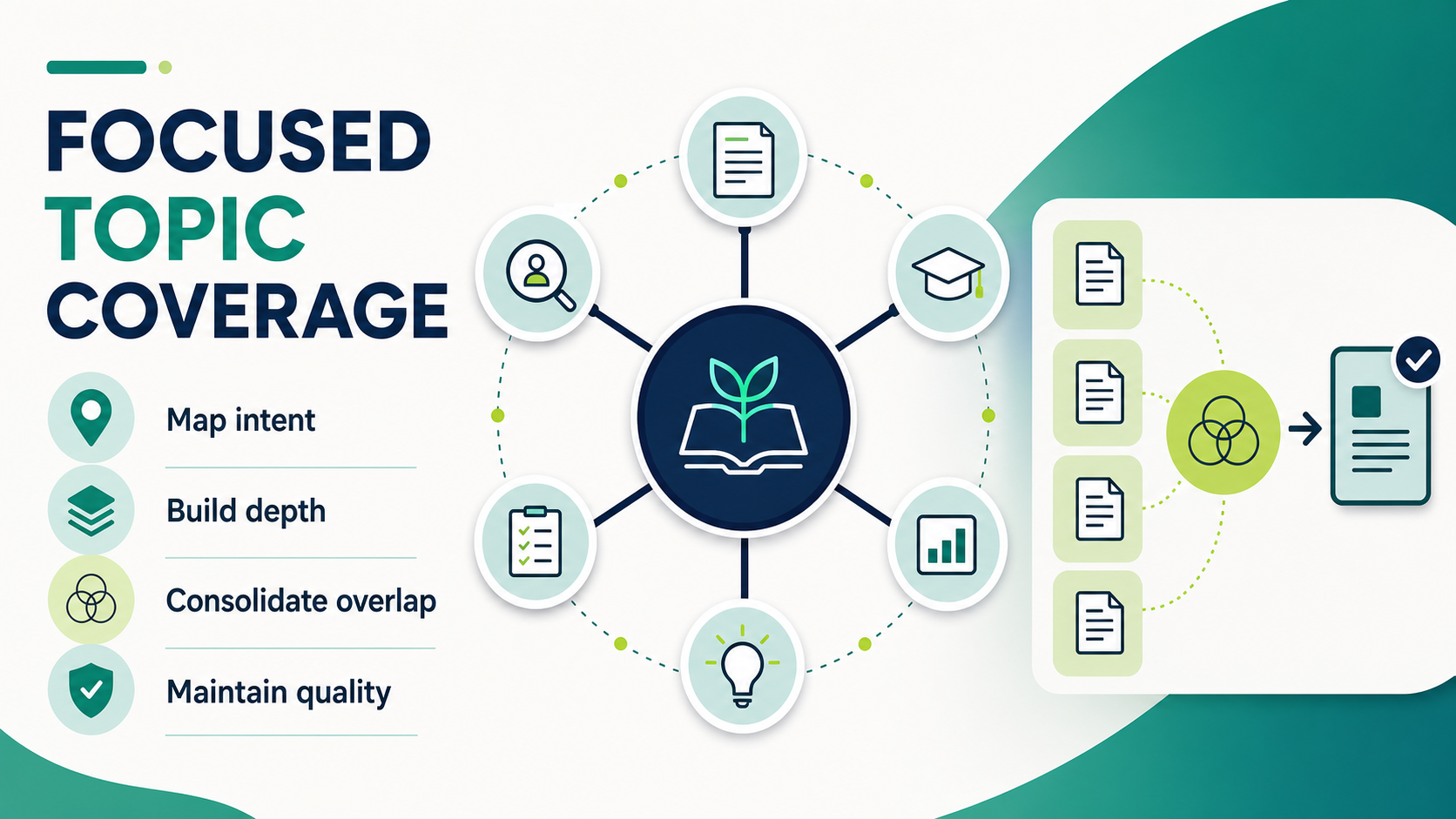
Topical authority content strategy works best when agencies treat it as editorial architecture instead of a race to publish more pages. This approach gives teams a repeatable operating model that maps intent, sets evidence standards, consolidates overlaps, and maintains clusters through governance so client sites gain focused coverage without content bloat.
What Topical Authority Actually Means for SEO Teams
Topical authority describes comprehensive, intent-matched coverage of a subject rather than any public Google score. Teams build it through deliberate editorial decisions about what belongs on the site and what does not. Google’s helpful content guidance says content should be created for people first, not search engines first. That principle directly shapes how agencies decide which subtopics earn pages and which get folded into existing material.
Google does not publish a topical-authority score that site owners can optimize directly. The same documentation makes clear that E-E-A-T is not a single ranking factor or score. Quality and relevance emerge from multiple systems rather than a single internal metric, so chasing volume under the assumption that more pages automatically raise authority misses the point. Coverage must answer real user questions with unique value, and that requirement stays constant across every client vertical.
Editorial architecture therefore starts with mapping the subject’s natural boundaries. An agency identifies the core questions users ask, then assigns each question to one page that addresses it completely. Overlaps get consolidated before they reach production. The result is a site that signals depth through precision instead of sprawl. When teams stop treating topical authority as a volume contest, they allocate research time to verifying facts, checking intent fit, and removing redundancy. Those steps produce clearer, nonredundant coverage without inflating page counts or implying that page volume creates authority.
Mapping Search Intent to Avoid Redundant Pages
Screen every potential subtopic for meaningful search demand, business relevance, and topical fit before any page is commissioned.
Organize keyword research into topic clusters that match distinct search intents rather than grouping pages by minor keyword variations.
Reject subtopics that duplicate an existing page’s purpose even if the phrasing differs.
Assign each accepted subtopic to a single URL that satisfies one primary intent.
Document the decision so future audits can confirm why a page exists and whether it still meets the original criteria.
Ahrefs recommends building topical authority by organizing keyword research into topic clusters, then producing content that matches each cluster’s search intent. The same guidance stresses screening subtopics for meaningful search demand, business relevance, and topical fit before creating pages. Following both steps keeps clusters lean because only pages that clear all three filters reach production. Teams avoid the common pattern of publishing near-duplicates that compete with each other for the same clicks.
Designing Client Topic Clusters That Scale
A pillar page supported by intent-specific subpages creates the structure that lets clusters grow without sprawl. The pillar covers the broad question users ask first, while each subpage handles one narrower angle that still fits the same topic. Semrush recommends creating a pillar page plus subpages, then interlinking them so Google and users can understand the site structure. Surfer SEO adds that internal links should connect pillar and supporting pages and that pages should address different search intents. Neil Patel’s topical-authority guidance says to go deep, not wide, by focusing on a few core topics and covering every angle.
Internal links function as the connective tissue. They guide visitors from the pillar to the precise subpage that answers their follow-up question and back again. This pattern also helps crawlers discover every piece of the cluster without requiring additional navigation pages. When a new subtopic clears the screening process, it joins the cluster through targeted links rather than as an isolated addition. The result stays organized because every new page reinforces an existing structure instead of starting a parallel one.
Evidence Standards Before Any Page Goes Live
Require each draft to demonstrate unique value that no existing page already delivers.
Confirm the page targets one distinct user intent that differs from every other URL in the cluster.
Verify original data, examples, or analysis appear on the page before it advances to review.
Consolidate or redirect when multiple URLs target the same intent.
Record the consolidation decision in the editorial log so the rationale remains visible during later audits.
Google’s duplicate-URL guidance explains how canonicalization can consolidate signals when the same or very similar content is available at multiple URLs. For an editorial team, the safer upstream practice is to avoid creating those overlaps in the first place. If a proposed page merely rephrases an existing article or serves the same intent, merge the useful material into the stronger URL instead of launching another page.
Maintaining Clusters Without Adding Bloat
| Maintenance Practice | Without Governance | With Governance |
|---|---|---|
| Quarterly cluster reviews | Pages accumulate outdated facts and broken links that erode trust | Ahrefs lists keeping content fresh and clusters complete as a core part of building topical authority; Sedestral recommends quarterly reviews of each cluster for broken links, outdated information, and new competitor content |
| Internal link placement | Links appear randomly or not at all, leaving users and crawlers without clear paths | Sedestral recommends roughly 3–5 relevant internal links per 1,000 words to guide users without clutter; links are audited on the same quarterly cycle |
| Content updates | New pages are added for every emerging angle regardless of overlap | Existing pages receive targeted refreshes that preserve intent match and eliminate the need for additional URLs |
Ahrefs lists keeping content fresh and clusters complete as a core part of building topical authority. Sedestral recommends quarterly reviews of each cluster for broken links, outdated information, and new competitor content, along with roughly 3–5 relevant internal links per 1,000 words to guide users without clutter. Applying both practices on a fixed schedule prevents the gradual expansion that turns focused clusters into bloated site sections.
Run a practical cluster audit before adding another URL
Start with the existing URLs in one cluster and write the primary intent of each page in a single sentence. Mark pages whose descriptions are interchangeable, pages with no meaningful internal links, and pages that have received no useful update despite changed facts or offers. For every overlap, choose one action: keep both because the intents differ, merge the weaker material into the stronger URL, or retire an obsolete page with an appropriate redirect.
Then inspect the cluster as a reader would. The pillar should explain the broad subject and link to narrower answers at the point where those questions arise. Supporting pages should link back to the pillar and to closely related next steps, using descriptive anchor text. Record the decision, owner, and review date so the same idea is not commissioned again six months later.
Agencies can use this repeatable system to connect intent mapping, consolidation rules, internal linking, and scheduled reviews. Measure the outcome with cluster-level impressions, clicks, conversions, and the number of overlapping or orphaned URLs—not with an invented topical-authority score.