
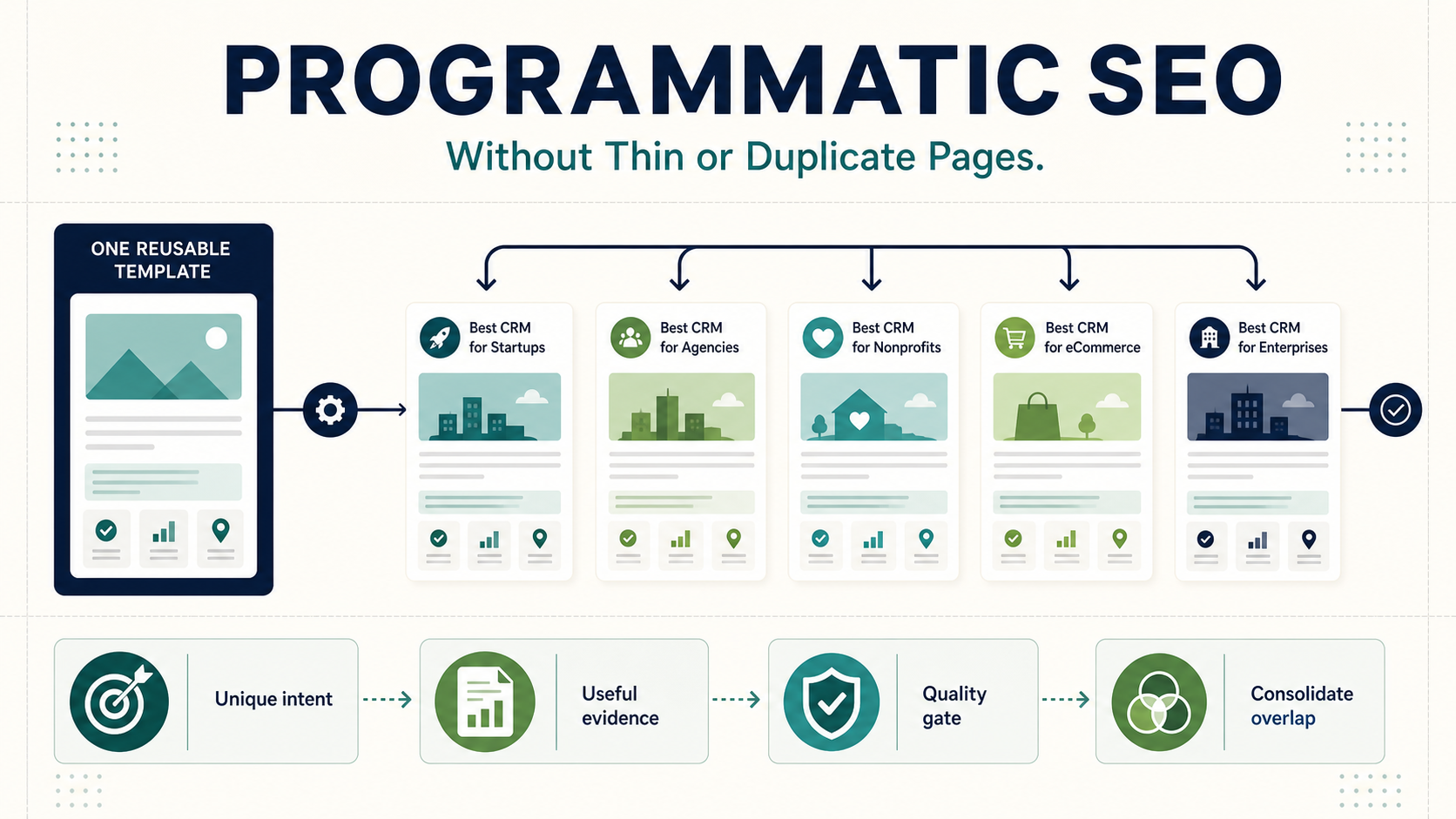
Programmatic SEO can help an agency serve many useful, specific search needs without writing every page from scratch. It can also create thousands of repetitive pages that add little value. The difference is not the number of URLs. It is whether each page has a clear audience, a defensible reason to exist, unique information, and a review process that catches failures before they spread.
This guide presents a practical workflow for planning, piloting, and maintaining scaled pages. It separates documented Google policies from operating recommendations and avoids promises about rankings or indexation.
What programmatic SEO should—and should not—do
A good programmatic system combines a reusable page structure with data or analysis that changes meaningfully for each search need. Examples include location pages with genuinely local service details, integration pages with verified setup instructions, or comparison pages built from maintained product data. The template provides consistency; the page-specific evidence provides usefulness.
The system should not manufacture superficial variations of the same answer. Google's spam policies identify doorway abuse as pages created to rank for similar queries while funneling users to one destination. Google's scaled content abuse policy focuses on producing many pages primarily to manipulate rankings, regardless of whether automation, people, or both created them.
Scale is therefore not a quality signal by itself. Before building a template, write down the user decision the page supports, the information that must be unique, and the condition under which the page should not be published.
Step 1: Define the page contract
A page contract turns an idea into testable requirements. It should describe the intended reader, search intent, required data, editorial contribution, conversion path, and exclusion rules.
- Audience: Who needs this specific variation, and why is a general guide insufficient?
- Unique inputs: Which facts, examples, calculations, or recommendations change from page to page?
- Source ownership: Where does each input come from, how often is it updated, and who resolves conflicts?
- Editorial value: What interpretation helps the reader use the data rather than merely displaying it?
- Exclusion rule: Which combinations lack enough evidence or demand to justify a standalone page?
If the only variable is a city, product name, or keyword inserted into otherwise identical paragraphs, the contract is too weak. Strengthen the underlying dataset, consolidate the intent into a broader page, or do not launch the page type.
Step 2: Design templates around variable evidence
Build the template after the data contract, not before it. Mark every section as fixed, conditional, calculated, or editorial. Fixed sections explain concepts shared by all pages. Conditional sections appear only when supporting data exists. Calculated sections show transparent comparisons. Editorial sections explain tradeoffs using the page's actual inputs.
Avoid hiding missing data behind generic filler. If a required field is absent, suppress the section or hold the page as a draft. Add validation for empty values, repeated paragraphs, conflicting units, expired offers, broken links, unsupported superlatives, and claims that cannot be traced to a source.
Metadata also needs rules. Titles and descriptions should accurately reflect the page, but generating hundreds of slightly different tags does not create hundreds of distinct experiences. The page body, navigation, and evidence must support the same intent.
Step 3: Launch a small pilot batch
Start with a representative sample rather than the easiest records. Include strong data, sparse data, unusual values, edge cases, and pages that should be rejected. A batch of 20 to 50 pages is often enough to reveal template problems without creating a large cleanup project; the exact number depends on page complexity and review capacity.
Review the pilot with a checklist:
- Does every page answer a distinct, useful question?
- Can an editor identify the unique evidence within a few seconds?
- Are important claims traceable to maintained sources?
- Do conditional sections disappear cleanly when data is missing?
- Are canonical tags, status codes, structured data, and internal links correct?
- Would two similar pages be better consolidated?
- Can the team update or retire the page when inputs change?
Keep pilot pages in draft or a controlled test environment until content and technical checks pass. An indexing request is not a substitute for this review and does not guarantee inclusion in Google Search.
Step 4: Build deterministic quality gates
Quality gates should stop publication, not merely produce a report nobody reads. Block pages with missing required data, duplicated primary sections, unresolved placeholders, invalid destinations, unsupported claims, or output below the page contract's minimum evidence threshold.
Add similarity checks across generated pages, but interpret them carefully. Shared navigation and explanatory copy are expected in a template. The important question is whether the central answer, examples, and recommendations are meaningfully different. Sample human review remains necessary because a numerical similarity score cannot judge usefulness on its own.
Connect approved pages to the rest of the site where the relationship helps readers. The guide to scaling internal links across topic clusters provides a repeatable workflow for page mapping, anchor text, and coverage measurement.
Step 5: Measure a cohort, not isolated wins
Track pages by template version and launch batch. Operational measures should include validation failure rate, pages held for review, source freshness, broken links, duplicated sections, and time required for an editor to approve a page. These metrics reveal whether the production system is stable.
Search Console can help teams observe indexing status, queries, impressions, and clicks, but it does not prove that a template change caused an outcome. Compare cohorts over sufficient time, record major site changes, and avoid presenting correlation as certainty. Analytics can show reader engagement and conversion behavior, while a crawler can show depth, status codes, and internal-link coverage.
Define retirement rules before launch. Consolidate or remove pages when the underlying entity disappears, the data is no longer maintainable, or multiple pages converge on the same intent. Use appropriate redirects or status codes based on the replacement and preserve useful navigation.
Where SiteSeed fits in the workflow
SiteSeed can help agencies turn a page contract into structured briefs, research requirements, draft generation, internal-link suggestions, review gates, and explicit publication decisions. The system is most valuable when automation carries documented standards forward—not when it replaces judgment.
For teams building the broader operating model, the SiteSeed content-scaling guide explains how briefs, research, review, and publishing can work as one production system.
A practical go/no-go decision
Proceed when the team can explain why every URL deserves to exist, maintain its unique inputs, review failures before publication, and remove pages responsibly when the data changes. Pause when the business case depends mainly on publishing volume, when sources are unreliable, or when editors cannot distinguish one page's answer from another. A smaller collection of maintained pages is usually a better starting point than a large inventory the team cannot verify.
Document that decision with the template version, owners, review cadence, and rollback plan. This creates a record that clients and future team members can evaluate instead of relying on assumptions made during the initial launch.