
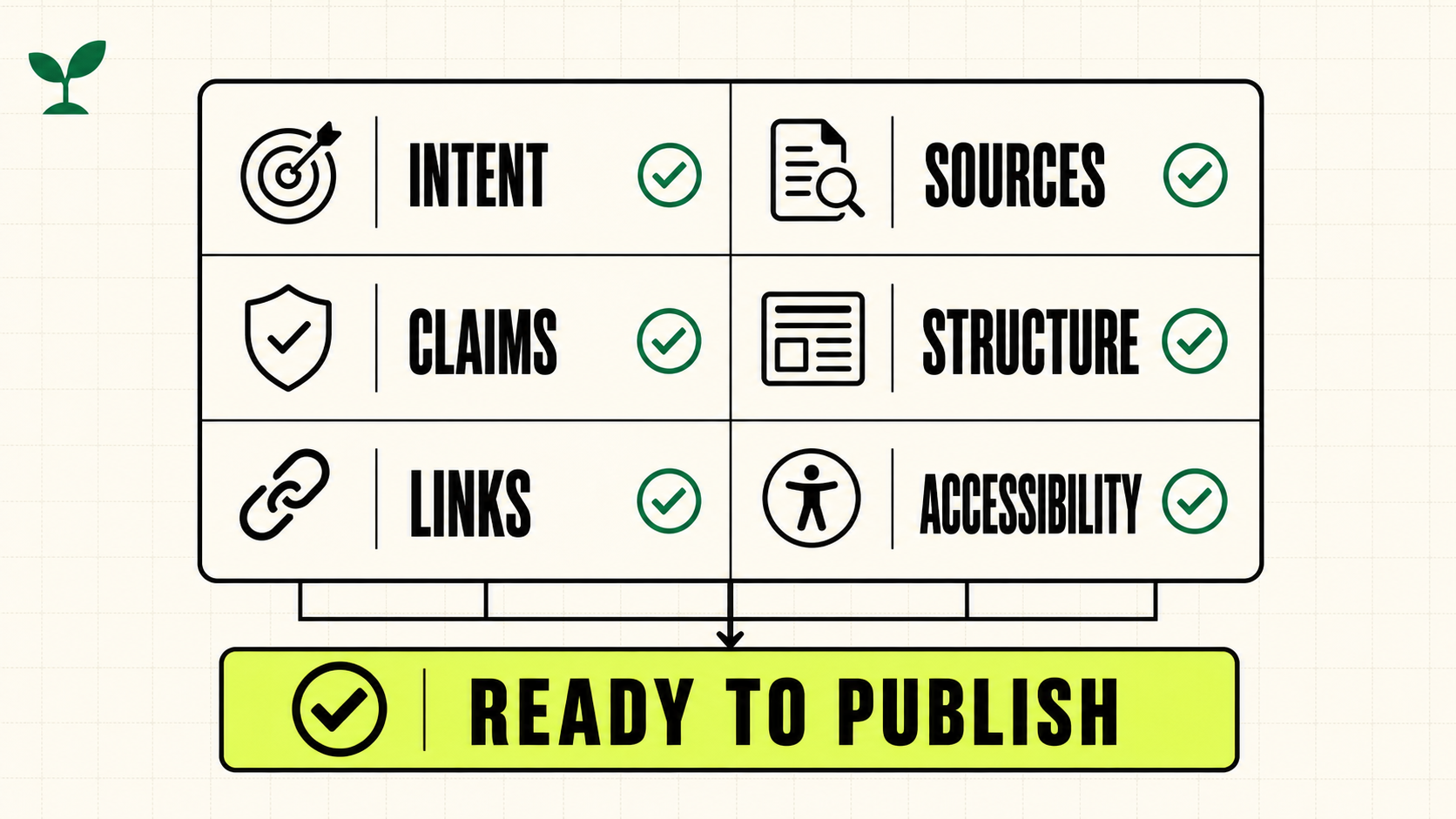
What does a complete SEO content quality checklist actually require before you publish, and which steps are backed by Google versus your own editorial standards? This blueprint delivers a labeled, pre-publish checklist that separates Google requirements (helpful content, E-E-A-T, indexability, mobile experience) from editorial best practices so lean teams can ship reliable, indexable pages without chasing myths or missing critical checks.
Align on search intent and audience before writing begins
Reviewing the current SERP results and top-ranking pages establishes whether the topic demands a how-to guide, a comparison, or a data-driven report. Teams that skip this step often produce content that matches surface keywords but misses the precise questions users type into search. Bruce Clay’s checklist suggests asking, before publishing: “Does this provide original value?” “Does it clearly satisfy search intent?” “Is the information accurate and current?” “Does it demonstrate experience or expertise?” These questions force an early check against what already ranks and what the searcher actually needs.
Defining the target persona and choosing the format that best serves that audience and topic prevents later rework. Search Engine Journal’s web content writing checklist asks whether you defined which persona you’re targeting and which format (video, blog, graphic, heavy image or text) best serves that persona and topic. A B2B buyer researching compliance tools needs different depth and evidence than a consumer comparing phone plans, so the chosen format must match both the persona’s habits and the topic’s complexity.
Creating a formal content brief that captures keyword usage guidance, word-count range, and success metrics turns intent alignment into a repeatable step rather than an afterthought. AgencyAnalytics outlines a 7-step web content process: 1) Keyword research, 2) Creating a content brief, 3) Writing, 4) Editing, 5) SEO review, 6) Approval, 7) Analyze and iterate. The brief becomes the shared reference that editors, writers, and analysts use to keep every later checklist item pointed at the same reader and outcome.
Verify E-E-A-T signals and source-level accuracy
Google’s people-first content guidance encourages creators to produce helpful, reliable content for an intended audience. Its quality guidance uses experience, expertise, authoritativeness, and trustworthiness (E-E-A-T) as a framework for assessing results, with trust as the most important element; Google does not describe E-E-A-T as a single ranking factor or public score. For editors, the practical check is whether the page answers a real reader need, demonstrates appropriate experience, and makes consequential claims easy to verify.
Requiring source-level fact checking with citations from authoritative references builds the trustworthiness component. Each claim that could affect a reader’s decision must trace back to a primary document or recognized expert. Without that trail, even well-written sections can read as unsubstantiated opinion to readers and reviewers.
Asking the four Bruce Clay questions completes the E-E-A-T verification: “Does this provide original value?” “Does it clearly satisfy search intent?” “Is the information accurate and current?” “Does it demonstrate experience or expertise?” Running these questions against the finished draft surfaces gaps in originality or authority that earlier planning steps may have missed. The process stays grounded in Google’s stated emphasis on helpful, reliable content rather than in speculative ranking tactics.
Structure content for readability and on-page SEO
Maintaining proper heading hierarchy, placing the focus keyword in the H1, and avoiding skipped levels or overly long headings follows SE Ranking recommendations for heading optimization. When headings follow a logical sequence, both readers and crawlers can parse the page without friction. The H1 serves as the single, clear promise of what the page delivers.
A concise opening summary helps readers decide whether the full piece matches their need. Treat the length as an editorial choice: explain the outcome and intended audience without duplicating later sections or padding the introduction for search engines.
Set article length according to the search intent, evidence required, and complexity of the answer. Google does not specify a preferred word count or keyword frequency. Use the primary term where it clarifies the subject, then edit repeated phrasing that makes the copy sound mechanical.
Run technical, accessibility, and media checks
Using an accessibility tool to flag issues like color contrast and missing labels, then checking for broken links, follows Siteimprove’s pre-publish recommendations. These checks catch barriers that frustrate users across devices and assistive technologies.
Optimizing every image, adding descriptive alt text and filenames, and verifying that alt attributes support relevance and accessibility is listed in both Orbit Media and Bruce Clay checklists. Bruce Clay’s SEO checklist lists image optimization and alt attributes as required on-page factors, alongside title tag, meta description, heading tags, and schema markup. Descriptive alt text helps screen-reader users understand informative images; decorative images should use empty alt text. Filenames, dimensions, and compression remain separate asset-management and performance checks.
Confirming the page is published rather than left as a draft, carries no noindex tag, and that robots.txt allows crawling comes from WordStream and SE Ranking instructions. WordStream’s SEO checklist requires teams to verify posts do not have a noindex meta tag or robots directive blocking them. SE Ranking’s 2024 SEO checklist instructs teams to access the website’s robots.txt at www.yourwebsite.com/robots.txt and confirm search engine bots can access it. These steps ensure the finished page can actually be discovered.
Finalize metadata, internal links, and publishing state
Write a clear, specific title tag that accurately summarizes the page and uses the main topic naturally. Google may truncate or rewrite title links depending on the query and device, so review the search preview rather than treating one character limit as a guarantee.
Adding internal links to related relevant pages and ensuring other pages link back to this target page with strategic anchors strengthens the content’s position within the site. Siteimprove includes adding internal links to related, relevant pages or resources as a content optimization step. Orbit Media’s on-page SEO checklist lists internal page linking as a best practice and recommends including links from other pages that point back to the SEO target page.
Logging the update type and date for future refresh tracking supports ongoing measurement. Siteimprove recommends logging update type (minor refresh, new sections, complete rewrite) and date, then tracking rankings, traffic, and conversions post-update. This record turns each publish into a data point rather than an isolated event.
Verify accessibility and performance after publish
After publishing, confirm that the live URL returns the intended page, remains indexable, and appears in the XML sitemap. Search Console’s URL Inspection report can show Google’s current view of the URL, but inspection or sitemap submission does not guarantee immediate indexing. Monitor Core Web Vitals, mobile usability, traffic, and conversions on an appropriate timeline for the site.
Scheduling a refresh cadence based on performance data and content age keeps the page aligned with both user expectations and Google’s emphasis on current information. Siteimprove’s guidance on logging update type and tracking outcomes supplies the data needed to decide when a refresh moves from optional to necessary. This final step treats the checklist as an ongoing system rather than a one-time gate.
Use this labeled checklist inside your existing 90-day content plan, programmatic SEO pipeline, and internal-linking workflows so every new page is intentionally aligned, factually defensible, technically sound, and ready for ongoing measurement.