
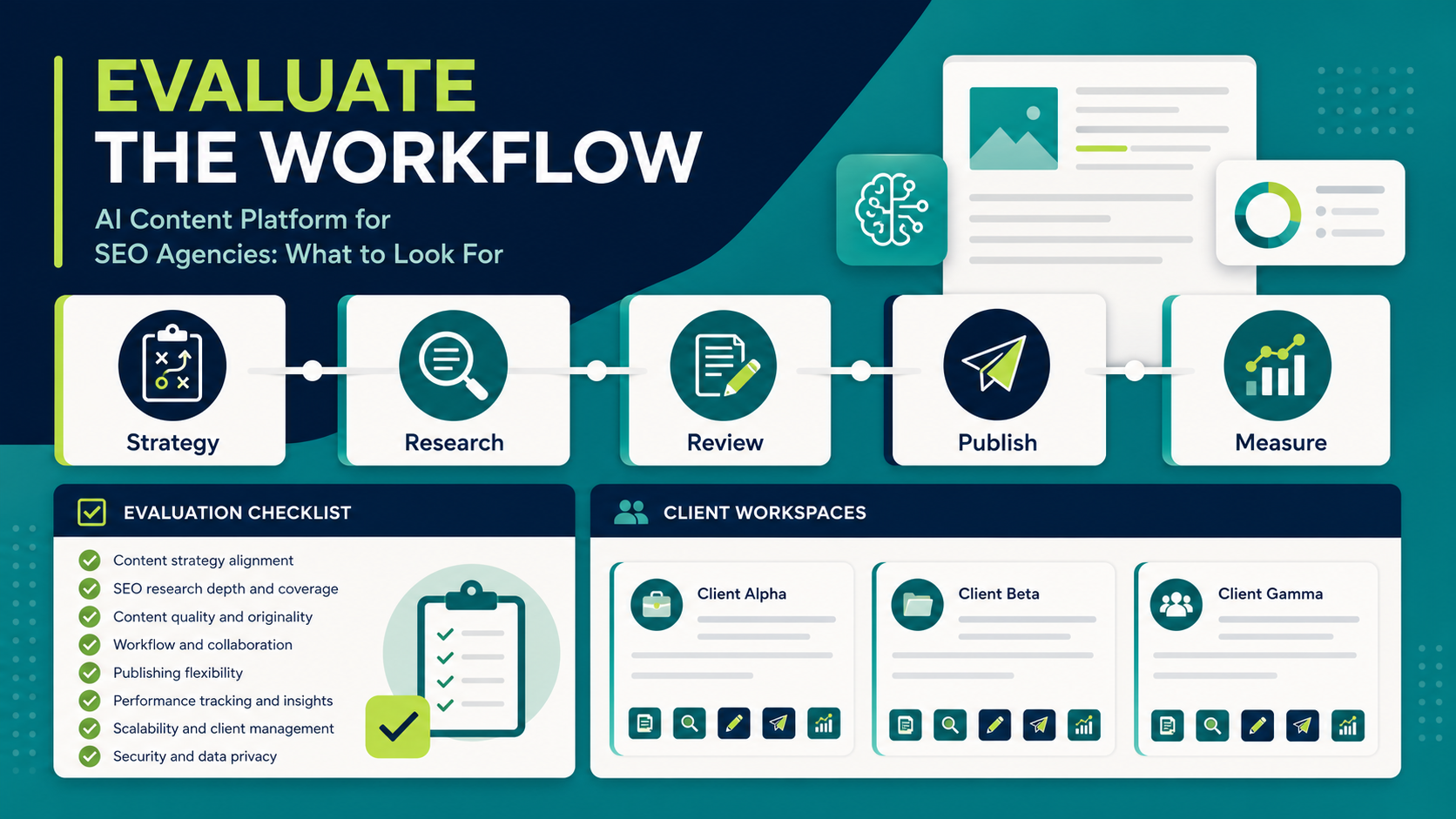
What makes an AI content platform for SEO agencies truly effective when managing multiple clients, rather than just another generic writing tool? Agency leaders evaluating options must look past basic text generation and toward systems that operationalize the full content lifecycle, from initial research through controlled publishing, while protecting client separation and cost predictability.
Why Most AI Writing Tools Miss the Mark for Agency Workflows
Single-user writing assistants often promise speed but leave agencies exposed when client volume grows. Agencies require multi-client separation, role-based permissions, and compliance checkpoints that extend well beyond prompt-based output. The focus therefore shifts from isolated drafting to coordinated content operations that incorporate strategy briefs, source tracking, and gated approvals before anything reaches a client site.
Many products advertise keyword research, drafting, optimization, or reporting. Those feature labels are not enough to establish agency fit. Buyers should test how the platform separates clients, records sources, handles revisions, controls publishing, and reports usage under a realistic multi-client workload. Treat each vendor claim as a hypothesis for the pilot, not proof that the workflow will scale.
Evaluating Strategy, Briefs, and SERP Analysis Capabilities
Strong platforms must deliver research that agencies can act on without rebuilding workflows from scratch. The following capabilities distinguish tools built for agency-scale work from narrower writing aids.
Clearscope generates a keyword-based content report, then recommends key terms, questions, and competitor insights to include based on pages currently ranking in top search results. This SERP-grounded approach supplies the factual backbone agencies need when creating briefs that survive client review.
While writing in Clearscope or Google Docs, users receive a content score that reflects keyword coverage, readability, and structural factors. Live scoring inside the editor surfaces gaps before drafts circulate, cutting revision rounds.
Surfer SEO’s workflow integrates keyword research, competitor analysis, brief creation, and AI draft generation, with its Cruise Mode feature automating content creation from topic discovery to finished copy. The single environment keeps research and generation aligned so handoffs between strategists and writers stay minimal.
Cruise Mode in Surfer SEO automates the flow from finding topics to generating a completed article draft in one guided process. Agencies gain consistency across campaigns because the same data sources feed every brief and draft.
When these elements operate together, teams spend less time reconciling separate spreadsheets and more time refining arguments that match current search intent.
Research Provenance and Supporting EEAT Expectations
Platforms earn their place in an agency stack when they make source lineage visible rather than opaque. Google says the same foundational SEO practices apply to AI features in Search and that there are no additional technical requirements or special schema needed to appear in them. Source provenance is therefore an editorial safeguard rather than a shortcut to inclusion: agencies should retain the URLs and evidence behind consequential claims so reviewers can verify accuracy and add useful citations.
Google’s people-first guidance asks whether content serves an intended audience, demonstrates first-hand expertise where appropriate, and leaves readers feeling they learned enough to achieve their goal. A platform can support that standard by exposing research during drafting, but the agency still owns source selection, verification, and final editorial judgment. Provenance makes those checks easier; it does not guarantee rankings or inclusion in an AI-generated answer.
Editorial Controls That Keep Humans in Charge
Enterprise SEO teams use AI to create article briefs and layouts before writing, generate FAQs, sort keyword lists, and identify grammatical and structural issues. Agencies gain the most when these same capabilities sit behind review gates rather than functioning as one-click publish buttons. Useful controls include claim verification, citation review, duplicate-content checks, copyright and brand review, and explicit approval before a draft moves to a client environment. AI-detection scores should not be treated as proof of authorship or quality.
These controls preserve human accountability while still capturing efficiency. Briefs and layouts can be drafted automatically, yet the final sign-off remains with a strategist who understands the client’s voice and risk tolerance. Structural checks can catch heading hierarchy problems, missing metadata, or thin sections before publication. The pilot should measure whether these controls reduce revision time and errors for the agency’s own clients rather than relying on universal productivity or ranking claims.
Workspace Separation, Roles, and Multi-Client Data Protection
Dedicated workspaces prevent accidental leakage when the same team handles competing accounts. Role-based access lets junior writers see only the projects assigned to them while senior strategists maintain broader visibility across campaigns. This structure also simplifies NDA compliance because each client’s research, briefs, and drafts remain isolated by default.
Without these boundaries, agencies risk exposing proprietary keyword strategies or unpublished content during routine collaboration. Platforms that treat workspace separation as a core architectural feature rather than an afterthought scale more reliably when client count increases. Permissions can be adjusted per project without forcing manual file copies or external spreadsheets, keeping audit trails intact for compliance reviews.
Internal Linking, Templates, and Scalable Site Architecture
Templates and structured layouts allow agencies to produce hub pages and pillar content at consistent quality without reinventing navigation each time. Built-in internal linking suggestions help maintain topic clusters across client sites without requiring writers to manually map every connection. When these features are native to the platform, teams can enforce site architecture standards even as volume grows.
The same templates support repeatable production of landing pages that align with broader campaign goals. Internal linking tools surface opportunities based on existing content rather than requiring separate crawling sessions, which keeps the workflow inside one system. Agencies that standardize these elements across clients reduce the risk of orphaned pages or inconsistent cluster signals that dilute topical authority.
Cost Transparency, Publishing Safeguards, and Structured Pilot Testing
Agencies must examine token limits, seat costs, and add-on modules before committing, because hidden usage fees quickly erode margins once campaigns scale. Transparent pricing models let teams forecast expenses against client retainers instead of absorbing overages. Publishing safeguards such as approval queues and automatic version history further protect against premature live deployment of unvetted drafts.
A rigorous pilot tests real multi-client workflows with defined success metrics rather than generic trials. Agencies should run parallel projects for at least one full content cycle, measuring time saved against revision volume, data isolation incidents, and actual output quality scores. The resulting data reveals whether the platform supports the agency’s specific operational requirements before any long-term contract is signed.
Where SiteSeed fits in the evaluation
SiteSeed is designed around the workflow rather than a blank writing box: it researches a topic, builds the brief and draft, verifies claims against the research, generates article assets, and can publish to WordPress or a hosted content hub. When a generated article does not satisfy its publication checks, it remains a draft for human review instead of being treated as publish-ready.
Agencies should still evaluate it with the same scorecard used for any vendor. Create two representative client sites, review source quality and editorial controls, confirm that site settings and content stay separated, inspect token usage, and test both a clean article and one that requires revision. The goal is to verify operational fit, not to assume that automation removes editorial responsibility.
Use these criteria to run a disciplined pilot that validates workflow fit, data controls, and cost predictability before committing to any AI content platform for SEO agencies.